
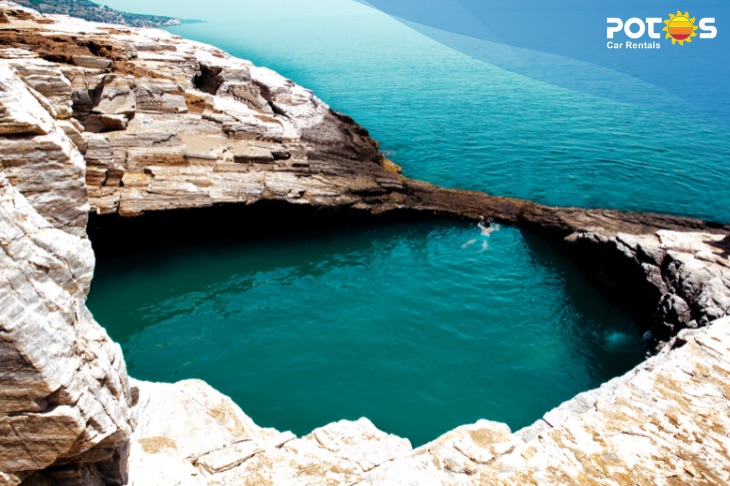
About this guide: Written by the editorial team at Potos Car Rentals, a Greek-licensed car-hire operator with seven branches across Thassos. Our local team visits Giola throughout the season and updates this guide based on on-the-ground conditions. GNTO licence 0155E81000014200.
Safety notice: Giola has no lifeguards on duty. Cliff jumping should only be attempted after checking the water depth at your entry point. Local guides recommend a maximum jump height of 4 meters. Rocks are slippery when wet. Children must be supervised at all times. In an emergency, dial 112 (Greek emergency services).
Giola Natural Lagoon – also called “Aphrodite’s Tear” and the “Eye of Zeus” – is a natural seawater rock pool on the southern coast of Thassos Island, near the village of Astris. The pool measures 20 m long, 15 m wide, and reaches 3 m deep at its northern end, with smooth rock walls, a sandy bottom, and surrounding cliffs up to 8 m high used for cliff jumping. Carved by Aegean waves over millions of years, Giola is one of the most photographed natural attractions in the northern Aegean – free to enter, open 24/7, and reached by a 2-3 km unpaved road from Astris (10 km east of Potos).
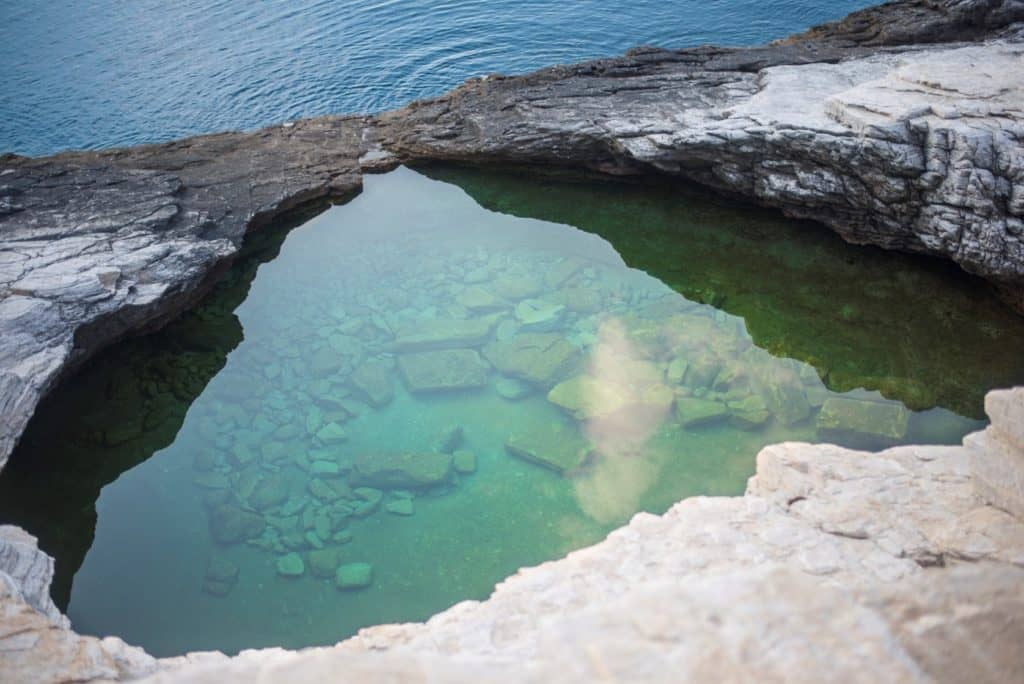
The water is emerald to deep blue, slightly warmer than the surrounding sea, and so clear that the rock walls show every contour underwater – earning Giola its informal nickname as a “natural infinity pool.” Across the water sits the small uninhabited island of Astiriotiko (also called the Virgin Mary island), said in local folklore to be visited by Sirens.
What Is Giola Thassos?
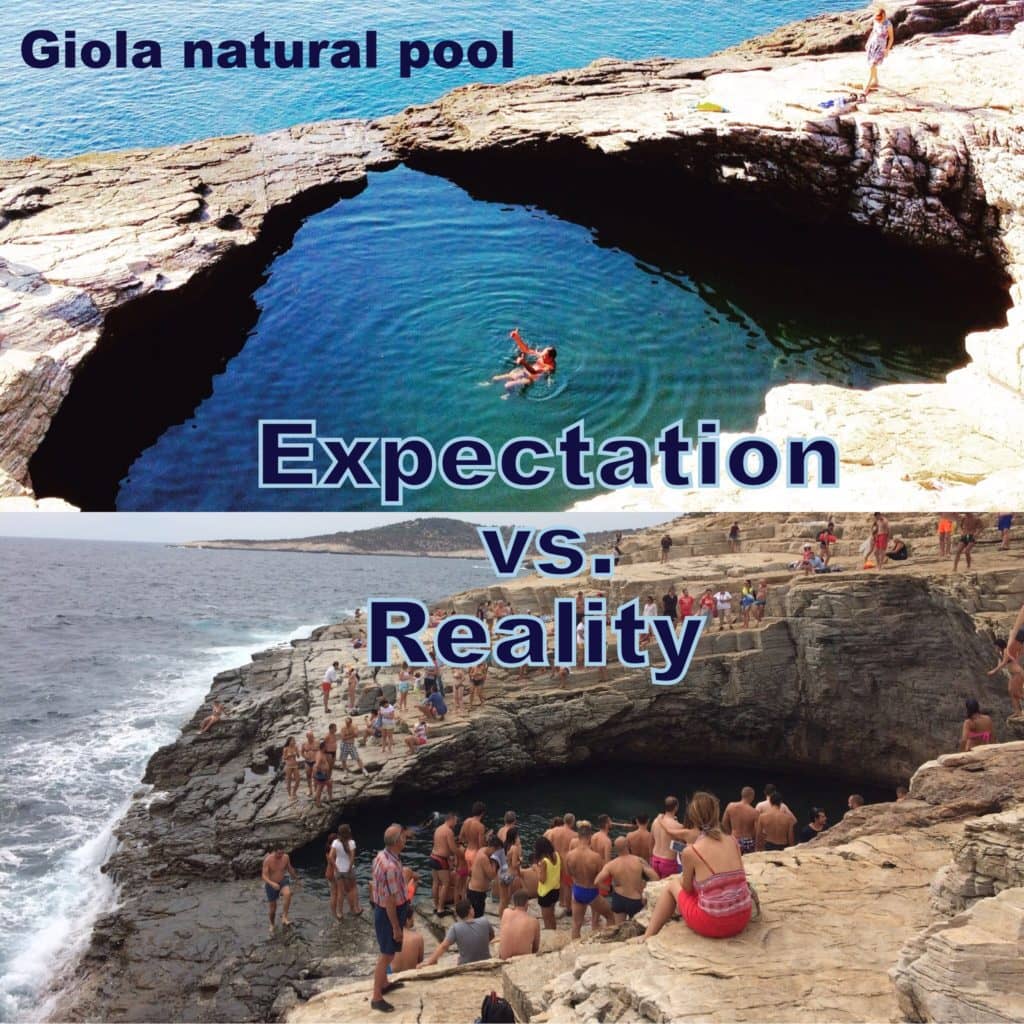
Giola is a natural seawater rock pool carved into the rocky coastline of southern Thassos by millennia of Aegean wave action. It measures 20 meters long, 15 meters wide, and reaches 3 meters deep at its northern end. The smooth limestone walls, sandy bottom, and surrounding cliffs (up to 8 m high) make it ideal for swimming, snorkelling, cliff jumping, and rock sunbathing.
Giola straddles three worlds: geology (a living example of Aegean coastal erosion), mythology (sacred to Aphrodite in local legend), and ecotourism (around 100,000 annual visitors, yet zero permanent infrastructure on site).
How Did Giola Form?
Giola carved itself out of Thassos rock over millions of years – constant Aegean waves dissolving and widening a coastal hollow until a natural swimming pool emerged. The pool is replenished by waves washing over the seaward edge, keeping the water fresh and slightly warmer than the open sea. Local residents historically maintained a small pump system to assist water exchange in calm weather; the pool is now self-replenishing through wave action alone.
What Is the Mythology Behind Giola?
Greek mythology offers two explanations for Giola’s existence:
- Aphrodite’s Tear: Zeus is said to have created the lagoon as a private bathing pool for his wife, Aphrodite. The name “Aphrodite’s Tear” reflects the legend that the goddess shed a single tear of joy into the rock – and the pool formed from it.
- Eye of Zeus: A second legend describes Zeus shaping the pool as a divine eye through which to gaze upon his beloved Aphrodite, giving it the alternative name “the Eye of Zeus.”
The first mythological reference to Giola dates back to ancient Greek times (~500 BCE). Across the water, the small uninhabited island of Astiriotiko is said in local folklore to be where Sirens come to swim.
How Deep Is Giola and How Big Is It?
| Dimension | Value |
|---|---|
| Length | 20 m (66 ft) |
| Width | 15 m (49 ft) |
| Maximum depth | 3 m (10 ft) in the northern section |
| Cliff height (jumping points) | 1-8 m (3-26 ft) |
| Recommended max jump height | 4 m (13 ft) – to avoid hitting the rocky bottom |
The pool is shallow at the southern edges (wadeable) and deepest at the northern end (3 m), which is the safest area for swimming and cliff jumping. Always check water depth at your specific entry point before jumping – wave conditions cause depth to fluctuate.
What Does Giola Look Like?
Seen from the side, Giola resembles a heart; from above by drone, it looks like a teardrop – which fits the Aphrodite’s Tear name perfectly. The water shifts between emerald, turquoise, and deep blue depending on the angle of sunlight and the day’s wave conditions. The rocky surroundings, smoothed by millennia of erosion, are pale and reflective – adding to the lagoon’s “infinity pool” effect.
Where Is Giola Lagoon?
Giola sits on the southern coast of Thassos Island near the village of Astris, at coordinates 40°35′10″N 24°40′43″E. From Potos it is 10 km east; from Limenaria it is 6.7 km east. From Limenas (Thassos Town), the drive is approximately 40 km south.
How to Get to Giola from Potos and Limenaria
From either Potos or Limenaria, drive east on the main coastal road toward Astris. Pass through Astris village, continue past the Aeria Hotel, and after about 100 m a small blue directional sign marked “Giola” appears on the right. From this point, a 2-3 km unpaved road leads to a free parking area, after which a short 300-400 m rocky footpath descends to the lagoon.
| Origin | Distance | Drive Time |
|---|---|---|
| Astris village | <1 km | 2 min + walk |
| Potos | 10 km | 15 min + walk |
| Limenaria | 6.7 km | 12 min + walk |
| Aliki | 9.9 km west | 15 min |
| Theologos | 21 km north | 30 min |
| Limenas (Thassos Town) | ~40 km north | 50 min |
Parking and the Canteen of Aphrodite’s Myth
The unpaved road ends at a free parking area. Next to the parking is a small seasonal canteen (sometimes called the “Canteen of Aphrodite’s Myth”) selling drinks, snacks, and basic refreshments. From the parking area, walk the rocky 300-400 m path down to the lagoon – sturdy closed-toe shoes are essential.
Insider tip: The unpaved road is rocky and rutted in places. A standard hatchback can manage it in dry weather, but a compact SUV or 4×4 is much more comfortable. Avoid driving in heavy rain.
What to Do at Giola
Giola’s main activities are swimming in the crystal-clear seawater pool, cliff jumping from heights between 1 m and 4 m (8 m is possible at the back wall but not recommended), snorkelling around the rocky edges, and rock sunbathing on the smooth surrounding limestone.
Swimming and Snorkelling
The water is exceptionally clear – visibility often exceeds 10 m. The pool is slightly warmer than the open sea because it is sheltered from the main current. Snorkellers can spot small fish among the rocks; watch for sea urchins in shallow corners and on the seaward rim.
Cliff Jumping at Giola – Safety Guide
Cliff jumping is one of Giola’s signature experiences. The rocks range from 1 to 8 meters high, but local guides recommend jumping no higher than 4 meters to avoid hitting the rocky bottom. Always check the water depth at your target entry point before jumping – it varies with wave conditions. The 3-meter maximum depth is only in the northern section; the southern end is significantly shallower.
⚠️ No lifeguards. No emergency services on site. The nearest hospital is in Limenas (~40 km). Dial 112 in any emergency.
Rock Sunbathing and Photography
The smooth limestone around the pool is ideal for rock sunbathing – bring a towel and avoid noon when the rock surface gets very hot. Drone photography is popular: the view from above showing Giola’s teardrop shape is the most-shared image of the lagoon. Always respect drone-flying regulations and other visitors’ privacy.
Organized Tours and Activities
Tours combining Giola with nearby attractions are available from Potos and Limenaria:
| Activity | Approximate Price/adult |
|---|---|
| Full-day boat cruise (from Potos / Limenaria, includes Giola stop) | €50-80 |
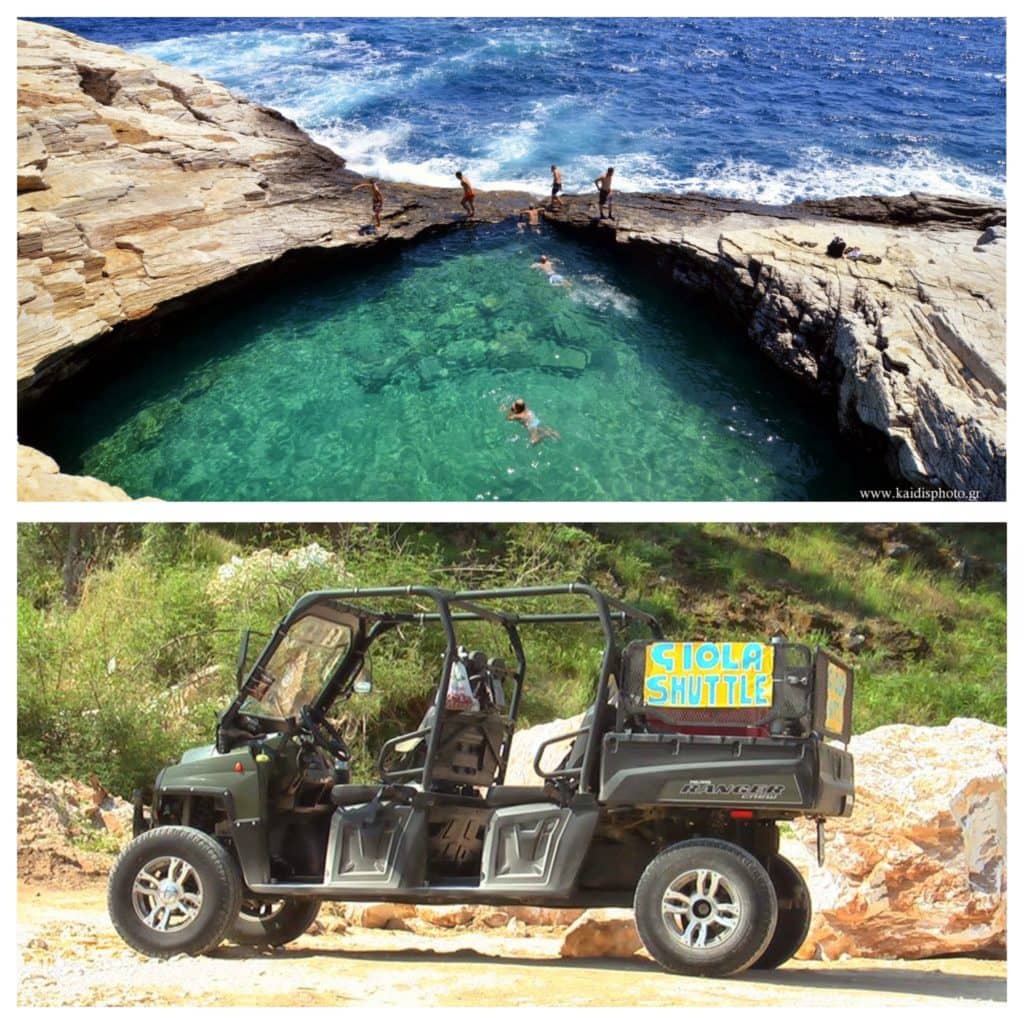
| 4×4 island safari (incl. Giola, Aliki, Paradise Beach) | €40-60 |
| Sea kayaking session | €25-40 |
Tip: Book directly at the port for the best rates – operators often run last-minute deals.
Best Time to Visit Giola Thassos
Visit Giola in May, June, or September for the quietest experience and mild weather (20-25 °C). In July-August, arrive before 9 AM or after 5 PM to avoid the midday heat and the largest crowds.
The earlier or later you visit during peak summer, the better the experience: morning light is best for clear-water photography, and late afternoon brings the warmest water temperature with the photography crowd already departing. The 11 AM-4 PM window is the most congested in July-August. According to Visit Greece 2023 data, visitor satisfaction was 32% higher in May and September compared to peak summer – primarily because of lower crowd density.
| Period | Air temp | Crowd level | Best for |
|---|---|---|---|
| April – May | 18-24 °C | Very low | Photography, solitude |
| June | 22-28 °C | Moderate | Best balance of warmth + crowds |
| July – August | 26-34 °C | Very high | Peak warm sea – visit before 9 AM |
| September | 22-28 °C | Low-moderate | Warm sea + shoulder season pricing |
| October | 18-24 °C | Very low | Photography (cooler swimming) |
What to Bring to Giola – Checklist
Giola has no on-site facilities beyond the seasonal canteen at the parking area, so come prepared:
- Water (1.5 L per person minimum – no taps on site)
- Sunscreen and a hat (no shade)
- Towel and swimwear
- Snorkel mask (optional but recommended)
- Sturdy closed-toe shoes or water shoes for the rocky path and pool edges
- Small first-aid kit (cuts on rocks are common)
- Camera or waterproof phone case
- Snacks – the parking-area canteen sells basic food and drinks but options are limited
- Cash for the canteen (cards may not be accepted)
Is Giola Safe?
Giola is generally safe but has no lifeguards on duty. The rocky terrain, slippery edges, and absence of safety steps mean visitors should take care. Wear closed-toe shoes for the path. Always check water depth before jumping. Children should be closely supervised.
Emergency contacts:
- European emergency: 112
- Thassos Police: +30 25930 22500
- Thassos Hospital (Limenas): +30 25930 71100
Responsible travel: Leave Giola as you found it. Do not remove rocks, shells, or sand. Carry out your waste. Fires are strictly prohibited. Do not disturb the marine life in or around the lagoon.
Nearby Attractions
| Attraction | Distance from Giola | Notes |
|---|---|---|
| Monastery of Archangel Michael | 4.8 km | Spiritual site with sea views; donations welcome |
| Psili Ammos Beach | 6.3 km west | Fine white sand, shallow water, family-friendly |
| Aliki Beach + Archaeological Site | 9.9 km east | Double bay with ancient marble quarries and ruins |
| Limenaria Village | 14.3 km west | Coastal town with restaurants, shops, dining |
| Theologos Village | 21 km north (inland) | Medieval mountain village with stone architecture |
| Golden Beach (Chrissi Ammoudia) | 30 km north | Blue Flag-certified, longest beach on Thassos |
Where to Stay Near Giola
| Hotel | Distance from Giola | Style | Price/night |
|---|---|---|---|
| Aeolis Thassos Palace | 3 km (Astris) | Modern with sea views, pool, spa | €80-150 |
| Astris Sun Hotel | 5.2 km | Family-friendly, since 1991 | €50-100 |
| EURO PARK HOTEL | 5.3 km | Modern, balconied rooms, pool | €60-120 |
| Royal Paradise Beach Resort & Spa | 8.3 km | 5-star luxury resort | €150-300 |
| Nautilus Luxury Studios | 11 km (Potos) | Studios with Aegean Sea views | €70-140 |
Where to Eat Near Giola
| Restaurant | Distance | Cuisine | Price/person |
|---|---|---|---|
| Tavern Klimataria (Potos) | ~10 km | Traditional Greek + seafood | €10-20 |
| Klimataria Tavern (Potos) | ~10 km | Greek + international | €10-20 |
| Taverna Leonidas | ~10 km | Traditional Greek | €10-20 |
| Tavern – Grill Georgios (Potos) | ~10.8 km | Grilled meats | €10-20 |
| Restaurant Dionisos (Limenaria) | ~14.5 km | Greek + Western | €10-25 |
| Stelakis Tavern (Limenaria) | ~16.5 km | Mediterranean | €10-20 |
How to Rent a Car for Giola Thassos
Renting a car is the most practical way to reach Giola – no public transport serves the site directly. A standard hatchback works on the paved section, but a compact SUV or 4×4 is recommended for the final 2-3 km of unpaved road.
Vehicle Types and Daily Costs
| Vehicle Class | Day Rate | Week Rate |
|---|---|---|
| Economy / compact (Toyota Aygo, Fiat Panda) | €30-50 | €210-350 |
| Mid-range / intermediate | €40-60 | €250-400 |
| Compact SUV / 4×4 (recommended for Giola) | €50-80 | €350-500 |
| Minivan (7-9 seats) | €70-100 | €450-700 |
What Kind of Car Do I Need?
- Standard hatchback: OK in dry weather; expect a slow, careful drive on the unpaved final 2-3 km
- Compact SUV / crossover: Comfortable on the unpaved section; recommended for most visitors
- 4×4: Best for confidence on rough patches, especially after rain
Requirements: Valid driving licence (EU licences accepted; non-EU visitors should carry an International Driving Permit), minimum age 21 (some operators charge a young-driver surcharge for drivers under 25).
Pickup locations on Thassos: Limenas (Thassos Town) Port, Limenaria, Skala Potamia, Skala Prinos, Potos, Kavala Airport (KVA).
Frequently Asked Questions
How deep is the Giola Lagoon?
Giola reaches 3 meters deep at its northern section. The southern edges are shallow enough to wade in. This makes the pool safe for swimmers and recreational cliff jumpers, provided they check water depth at the specific entry point before jumping.
Is Giola Beach worth visiting?
Yes – Giola is one of the most distinctive natural attractions in the northern Aegean. Its emerald, turquoise, and deep-blue water, sculpted rock walls, and “natural infinity pool” appearance make it unique on Thassos. Free entry, 24/7 access, and minimal commercial development preserve a genuine wild-swimming experience.
Is Giola Beach safe?
Generally yes, but Giola has no lifeguards. Wear sturdy closed-toe shoes – rocks are slippery and uneven. Always check water depth before cliff jumping. Supervise children at all times. Greek emergency: 112.
Do you need to book in advance to visit Giola?
No – Giola is a free natural site, open 24 hours a day with no reservation required. In peak season (July-August), arriving before 9 AM or after 5 PM avoids the worst crowds.
Are children permitted at Giola?
Yes, but with caution. The path down is rocky and the pool edges are slippery. Children must wear sturdy shoes for the descent and be closely supervised in and around the water. The southern section is shallower and safer for young swimmers; the northern 3 m depth is for stronger swimmers only.
How long does the walk from the parking area take?
About 5-10 minutes along a 300-400 m rocky footpath. The descent is steeper than the return. Bring shoes with grip – flip-flops are not recommended.
Can I visit Giola without a car?
It is difficult. There is no direct public bus to Giola; the nearest bus stop is in Astris village (15+ minutes’ walk from the unpaved access road). Most visitors arrive by rental car, by taxi from Potos/Limenaria, or via a boat tour from Potos or Limenaria harbour.
Sources: – Visit Greece (Greek National Tourism Organisation) – visitgreece.gr – visitor satisfaction data, 2023 – Hellenic Centre for Marine Research – coastal geomorphology context – On-site verification by the Potos Car Rentals editorial team, May 2026. – Visitor count figures vary across official sources between approximately 50,000 and 100,000 annually; this guide uses the upper estimate.
 Facebook
 Instagram
 Linkedin
 German
 Greek
Greek Română
 Polski